 Oldsmar Siding
 Siding Built for the Tampa Bay Climate
Homes on the Tampa side of Pinellas County live under a different set of stresses than a house a few hundred miles inland. Summers bring near-daily thunderstorms with wind-driven rain that finds every gap in a wall system. The sun is relentless almost year-round, which breaks down paint and lower-grade siding faster than most homeowners expect. And because this area sits close enough to the bay and gulf to pick up salt-laden air, metal fasteners, trim, and anything that isn't corrosion-resistant starts showing its age early. Add the real possibility of hurricane-force wind gusts, and it becomes clear why siding selection here isn't a cosmetic decision — it's a structural one.
We install exclusively James Hardie fiber cement siding, and we work this area regularly enough to know which failure points show up again and again on older homes: caulking that's dried and cracked at trim joints, paint that's chalked and faded on the sun-facing walls, and siding that's absorbed enough moisture over the years to soften at the bottom courses. A lot of that comes down to the material choice made decades ago, not bad luck.
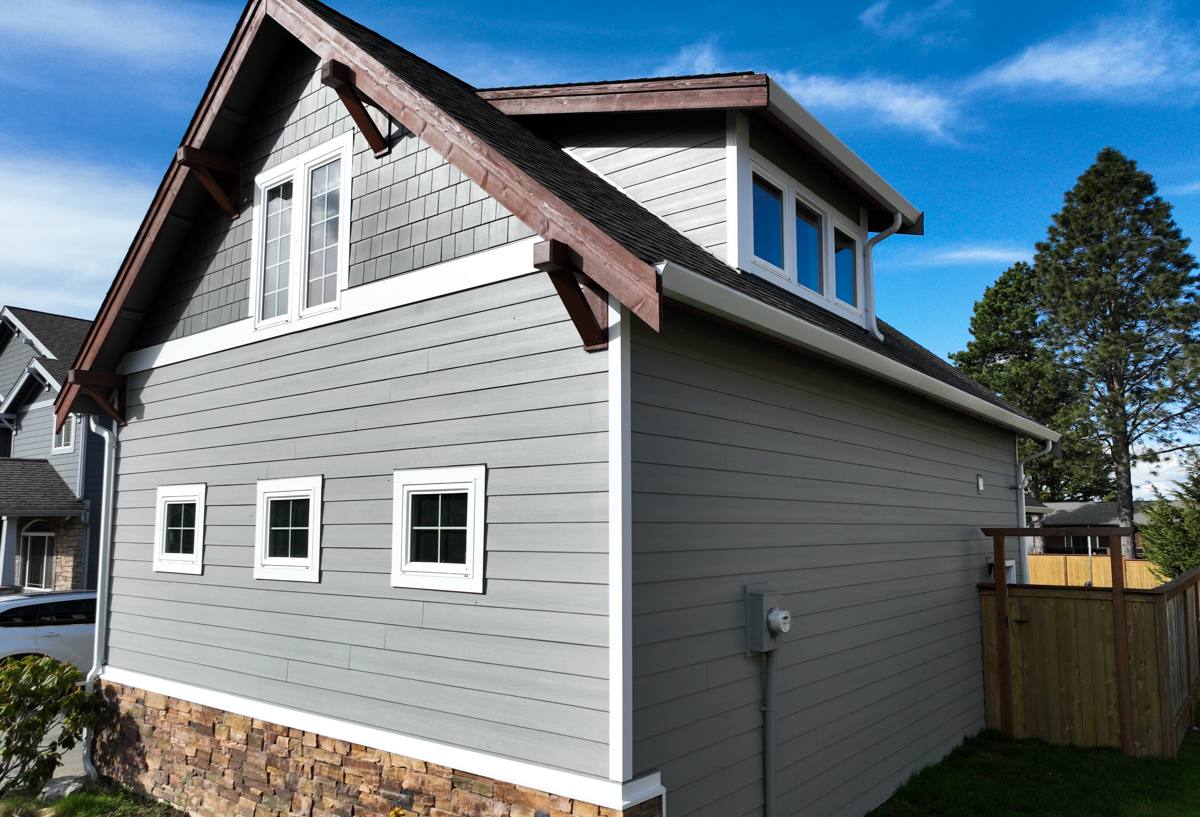
What Tampa-Area Homes Face Year After Year
Heat and UV Exposure
Florida sun is hard on exterior materials. Vinyl siding can warp or fade unevenly depending on orientation. Wood and wood-composite products need their paint or coating maintained on a strict schedule or they start absorbing moisture at the surface. Fiber cement handles UV exposure well because it isn't a petroleum-based product reacting to heat the way vinyl does, and James Hardie's factory-applied ColorPlus finish is baked on and warranted against fading in a way field-applied paint isn't.
Wind-Driven Rain
Tampa Bay's storm pattern isn't just about rainfall totals — it's about rain being pushed sideways into walls during high wind events. Siding systems that rely on perfect, ongoing caulk maintenance to stay watertight are the ones that eventually let moisture behind the wall. That's when you start seeing soft trim, staining, or in worse cases, rot in the sheathing underneath.
Salt Air and Corrosion
Being close to the water means airborne salt settles on every exterior surface, not just on homes directly on the coast. Over time it accelerates corrosion on unprotected fasteners and can degrade certain trim and siding materials faster than the same product would age further inland.
Storm and Wind Load
Pinellas County requires exterior products and installation methods that are engineered to hold up under high wind loads. That's not just a code checkbox — it's the difference between siding that stays put during a tropical storm and siding that peels off in sheets.
Why We Standardized on James Hardie
We made a decision as a company to install only James Hardie fiber cement siding, and to explain honestly why we won't install vinyl, LP SmartSide, or other wood-based composite siding on homes in this region. It's not that those products have no place anywhere — it's that for this specific climate, they carry trade-offs we're not willing to put our name behind.
- Fiber cement is non-combustible, which matters for both safety and, in some cases, insurance considerations.
- James Hardie's HZ5 product line is engineered specifically for high-humidity, storm-prone climates like ours.
- ColorPlus factory finish is baked on under controlled conditions, not applied on-site, so color consistency and fade resistance are built in rather than dependent on weather during installation.
- Fiber cement doesn't feed insects and doesn't swell or rot the way wood-based products can when moisture gets behind them.
- James Hardie backs the product with a strong, transferable warranty — valuable if you ever sell the home.
None of this means every alternative product is a poor choice for every climate. It means that after years of doing this work in Pinellas County, we decided we'd rather stand behind one system we trust completely than offer several options with very different long-term outcomes.
Comparing Common Siding Options for This Climate
| Factor | James Hardie Fiber Cement | Vinyl | Wood/Composite (e.g. LP SmartSide) |
|---|---|---|---|
| Moisture behavior | Resists moisture absorption; engineered HZ5 line for humid climates | Doesn't absorb water but can warp or buckle in heat | Vulnerable if edges/seams aren't sealed and maintained |
| UV/fade resistance | ColorPlus factory finish warranted against fading | Can fade unevenly, especially on sun-facing walls | Depends entirely on paint maintenance schedule |
| Wind performance | Engineered and tested for high wind-load regions | Can crack or blow off in high winds if not rated for the area | Performance varies by installation quality |
| Fire resistance | Non-combustible | Combustible | Combustible |
| Maintenance | Low — no repainting on factory-finish color | Low, but limited repair options once damaged | Higher — requires ongoing sealing/painting |
How We Approach a Siding Project in This Area
A good siding job starts before the first board goes up. On homes in Oldsmar, Tampa, and the surrounding Pinellas County communities, we look closely at what's happening behind the existing siding — moisture damage, soft sheathing, and how the current weather barrier is holding up — before we ever talk about color or style. Replacing siding over a damaged substrate just locks a problem inside the wall.
What a Proper Installation Includes
- Removal of old siding and inspection of the sheathing underneath for rot or moisture damage
- Repair or replacement of any compromised sheathing before new material goes on
- Installation of a code-compliant weather-resistant barrier
- Fastening per James Hardie's published specifications for wind zone requirements
- Proper flashing at windows, doors, and roof intersections — the most common places water gets behind siding
- Correct joint and butt-seam treatment to shed water rather than trap it
Installation quality matters as much as the product itself. Fiber cement that's fastened incorrectly, cut without the right blades, or flashed poorly will underperform no matter how good the material is. That's a big part of why we keep this work in-house with crews who install Hardie products regularly rather than occasionally.
Beyond Siding: Roofing, Windows, and Decks
Siding is rarely an isolated decision. On most homes, the roof, windows, and siding age on overlapping timelines, and problems in one area often show up as symptoms in another — a leaking roof valley that stains siding below it, or window flashing that's failed and is letting water into the wall cavity. We handle roofing, window replacement, and deck construction alongside siding so we can look at the whole exterior envelope rather than patching one component while ignoring what's feeding a problem into it.
For homeowners tackling a full exterior renovation, sequencing matters. Roofing and window work is generally best handled before or during a siding replacement, since siding installation ties into flashing at both.
What to Look For When Hiring a Contractor Here
Pinellas County's coastal exposure means not every contractor who does good work inland understands what this climate demands. Before hiring anyone for exterior work in the Tampa or Oldsmar area, it's worth asking a few direct questions.
| Question to Ask | Why It Matters |
|---|---|
| Are you licensed and insured in Florida? | Confirms legal standing and protects you if something goes wrong on the job |
| Do you install to the manufacturer's published fastening and flashing specs? | Determines whether the warranty is actually valid if a problem arises later |
| How do you handle sheathing repair if it's found during removal? | Reveals whether hidden damage gets fixed or covered up |
| What's your experience with wind-rated installations specifically? | Generic experience doesn't always translate to coastal wind-zone requirements |
A contractor who's vague on any of these is worth being cautious about. The exterior of a home is not a place where corners should be cut, especially in a region that sees regular tropical weather.
Signs It's Time to Replace Your Siding
- Visible cracking, warping, or buckling anywhere on the siding
- Soft spots when you press on the siding near the bottom of walls or around windows
- Paint that's peeling or chalking heavily despite recent repainting
- Persistent staining that suggests water is tracking behind the siding
- Rising energy bills that may point to a failing weather barrier behind aging siding
- Visible gaps or separation at trim and corner boards
Any one of these on its own might not mean immediate replacement, but a combination of a few is usually a sign the siding system as a whole is past its useful life.
Get a Straightforward Look at Your Home's Exterior
If you're in Oldsmar, Tampa, or elsewhere in Pinellas County and want an honest read on where your siding, roofing, windows, or deck actually stand, we're happy to take a look. There's no pressure and no sales script — just a straightforward assessment and a real estimate if you decide to move forward. Use the form below to request a free evaluation.