 Oldsmar Siding
 Forest Lakes Homes Face a Specific Kind of Wear
Forest Lakes sits inside Oldsmar, tucked into Pinellas County along the Tampa Bay corridor, and homes here deal with a climate that is harder on exterior materials than most of the country ever experiences. It isn't one dramatic event that wears a house down — it's the accumulation of ordinary days. Intense UV exposure nearly year-round bakes painted and coated surfaces. Afternoon thunderstorms drive rain sideways into walls rather than straight down. Salt-laden air drifting inland from Tampa Bay settles into seams, fasteners, and trim joints. And every hurricane season brings the possibility of sustained high winds and wind-driven rain that test every seam, joint, and fastener on the outside of a house.
None of this means a home in Forest Lakes is doomed to constant repair. It means the exterior materials and installation methods have to be chosen with this climate in mind, not borrowed from a builder's spec sheet written for a drier, milder part of the country.
What Heat, Humidity, and Salt Air Actually Do to Siding
UV and Heat Cycling
Florida sun is relentless. Materials that rely on paint film or surface coatings for protection — wood trim, some engineered wood products, older vinyl — chalk, fade, and become brittle faster here than in northern climates. Repeated heat cycling (scorching afternoons, cooler nights) also stresses seams and fastener points over years of expansion and contraction.
Moisture and Wind-Driven Rain
Pinellas County gets the bulk of its rain in short, intense bursts, often pushed horizontally by wind. Siding systems that aren't detailed correctly at seams, corners, and penetrations let that water find a way behind the cladding. Once moisture gets behind siding, the sheathing and framing underneath are what actually suffers — and that damage is invisible until it's expensive.
Salt Air and Corrosion
Forest Lakes isn't beachfront, but Tampa Bay's salt air travels well inland, especially with onshore wind patterns. Salt accelerates corrosion in fasteners, flashing, and any metal trim components. It also degrades certain coatings faster than inland climates would predict.
Wind Load
Every siding product has a wind-load rating tied to how it's fastened and installed, not just what it's made of. A hurricane-country installation has to follow fastening schedules and clearances that are frankly overkill for a house in Ohio — but exactly right for a house in Oldsmar.
Why We Only Install James Hardie Fiber Cement Siding
We made a deliberate decision, early on, to stop installing several products that are common elsewhere in the industry — vinyl siding, LP SmartSide, Cemplank, Allura, and primed spruce or cedar lap siding. That's not a knock on every contractor who installs them; it's a reflection of what we've seen these products do, specifically, in a Gulf Coast climate over a full ownership cycle.
Vinyl siding is affordable and easy to install, but it's a petroleum-based product that softens and can warp under sustained heat, and it relies on overlapping panels rather than a continuous, paintable surface — which matters when you're trying to match color decades later or repair storm damage to a single section. Wood-based and wood-look products (cedar, primed spruce, LP SmartSide) perform well when maintained perfectly, but they depend on an intact paint or coating layer to keep moisture out, and that layer is exactly what Florida sun and humidity attack hardest. Miss a maintenance cycle in this climate and moisture problems can start before you notice anything wrong on the surface.
James Hardie fiber cement is a genuinely different material system: cement, sand, and cellulose fiber, cured into a rigid board that doesn't burn, doesn't rot, and isn't a food source for pests. It ships with a factory-applied ColorPlus finish baked on under controlled conditions — a more durable, more UV-resistant finish than field-applied paint, and one that's engineered specifically to hold color and resist the kind of fading that Florida sun causes on lesser coatings. Hardie also builds climate-specific product lines, including an HZ5 formulation engineered for hot, humid, high-moisture regions like ours. That's the product family we standardize on for every home we side, including here in Forest Lakes.
The Hardie Product Lines We Use
| Product | Best Use | Why It Fits This Area |
|---|---|---|
| HardiePlank Lap Siding | Most exterior wall area | Traditional lap look, HZ5 formulation resists moisture and humidity damage |
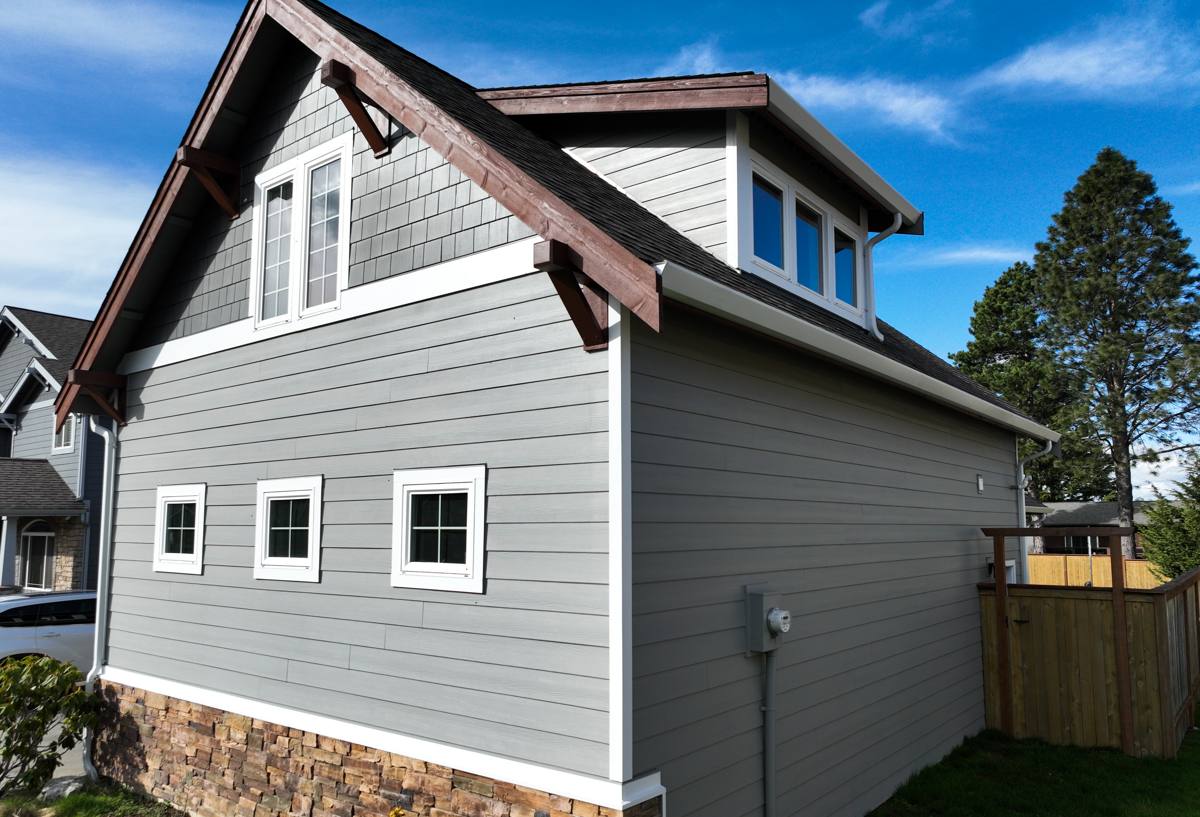
| HardieShingle | Accent gables, dormers | Adds texture and architectural interest without sacrificing durability |
| HardiePanel | Modern vertical/board-and-batten sections | Clean lines for contemporary facades, same non-combustible core |
| HardieTrim | Corners, fascia, window/door trim | Matches siding durability so trim doesn't fail before the field siding does |
| HardieSoffit | Vented and non-vented soffit areas | Resists humidity and pest intrusion at roofline, a common failure point |
How We Actually Install It
Fiber cement siding only performs to its rating when it's installed to spec — and in a wind-and-water climate like Pinellas County, the installation details matter as much as the product choice itself. Our crews follow Hardie's published fastening and clearance requirements rather than treating them as optional guidance, which includes:
- Correct fastener type, spacing, and embedment for our wind zone — not a generic nailing pattern
- Proper clearance between the bottom of the siding and roofing, decks, and grade, so water sheds away instead of wicking up into the board
- Weather-resistant barrier installed and lapped correctly behind the siding, so any incidental moisture has a drainage path
- Flashing at every window, door, and penetration — the single most common source of hidden water intrusion when skipped or done poorly
- Caulking and sealing only where Hardie's specifications call for it, since over-caulking can trap moisture just as easily as under-caulking
- Field-cut edges primed or sealed per manufacturer instructions, so cut ends don't become the weak point in an otherwise sound wall
This is also where a transferable warranty actually means something. Hardie's product warranty depends on the installation meeting their published requirements — a beautiful-looking installation that skips fastening schedule or flashing details can void the very protection a homeowner thinks they're getting. We document our installations for exactly this reason.
Siding Is One Piece of the Exterior — We Handle the Whole Envelope
Siding doesn't work in isolation. The roof above it, the windows set into it, and even the deck attached to it all interact with the same wind, water, and UV exposure. We handle roofing, windows, and decks alongside siding for Forest Lakes homeowners specifically because these systems need to be coordinated, not patched separately by different trades with no communication between them.
Roofing
A roof in poor condition undermines even a perfect siding installation — water finds the path of least resistance, and a compromised roofline often means water tracking down behind fascia and into top courses of siding. We evaluate roof condition as part of any full exterior assessment.
Windows
Window flashing integrates directly with the siding's weather-resistant barrier. Old, poorly flashed, or non-impact-rated windows are a common source of leaks that get blamed on siding when the window opening is the actual entry point.
Decks
Where a deck ledger board attaches to the house, that connection needs to be flashed correctly or it becomes a guaranteed moisture path into the wall assembly behind the siding — a detail that's easy to get wrong and expensive to fix after the fact.
Comparing the Real Trade-Offs
| Factor | Vinyl | Wood / LP-Type Products | James Hardie Fiber Cement |
|---|---|---|---|
| Fire performance | Combustible | Combustible | Non-combustible core |
| Moisture dependency | Low, but can warp/soften in heat | High — depends on intact coating | Low — HZ5 formulation for humid climates |
| Color durability in Florida sun | Fades, can chalk | Depends on repaint schedule | Factory ColorPlus finish, UV-engineered |
| Pest resistance | Not a food source, but seams can shelter pests | Vulnerable if coating fails | Not a food source for termites or pests |
| Maintenance cycle | Occasional cleaning | Repaint every few years, more in this climate | Repaint interval extended by factory finish |
| Warranty structure | Varies widely | Varies, often shorter | Strong transferable warranty when installed to spec |
Choosing a Contractor in Forest Lakes: What Actually Matters
Oldsmar and the surrounding Pinellas County area have plenty of exterior contractors, and the quality gap between them is wide. A homeowner comparing bids should look past the price on the page and ask harder questions:
- Is the crew factory-trained or certified on the specific product being installed, not just "experienced with siding" in general?
- Will they put the fastening schedule, clearances, and flashing details in writing, not just verbally promise "we do it right"?
- Do they carry active liability insurance and workers' compensation, and will they provide documentation without being asked twice?
- Are they familiar with local wind-zone and building code requirements specific to Pinellas County, rather than applying a generic national standard?
- Do they offer a genuine multi-trade assessment (roof, windows, siding, decks) instead of quoting siding in isolation from the systems it touches?
- Can they explain, specifically, why they recommend one product over another for this climate — not just push whatever they have the best margin on?
A local crew that works in this climate every week understands things a national installer passing through simply won't — how the afternoon storm pattern affects scheduling, which older Oldsmar neighborhoods tend to have specific moisture or drainage quirks, and what a Pinellas County wind-zone inspection actually looks for.
What Homeowners Can Do Between Service Visits
Even the best-installed siding benefits from basic homeowner attention. A simple annual routine keeps small issues from becoming expensive ones:
| Task | Frequency | Why It Matters |
|---|---|---|
| Visual inspection of caulking and seams | Annually, ideally before hurricane season | Catches gaps before wind-driven rain finds them |
| Gentle rinse to remove salt residue and pollen | 2-4 times per year | Prevents buildup that traps moisture against the surface |
| Check clearance at grade, decks, and roof intersections | Annually | Vegetation growth and mulch buildup can reduce required clearances over time |
| Post-storm walk-around | After any significant wind event | Identifies impact damage or loosened trim before the next storm arrives |
Ready When You Are
If you're weighing a siding replacement, or you just want a straight answer on whether your Forest Lakes home's current exterior is holding up the way it should, we're happy to take a look. There's no pressure and no scare tactics — just an honest assessment and a free estimate using a form below.