 Oldsmar Siding
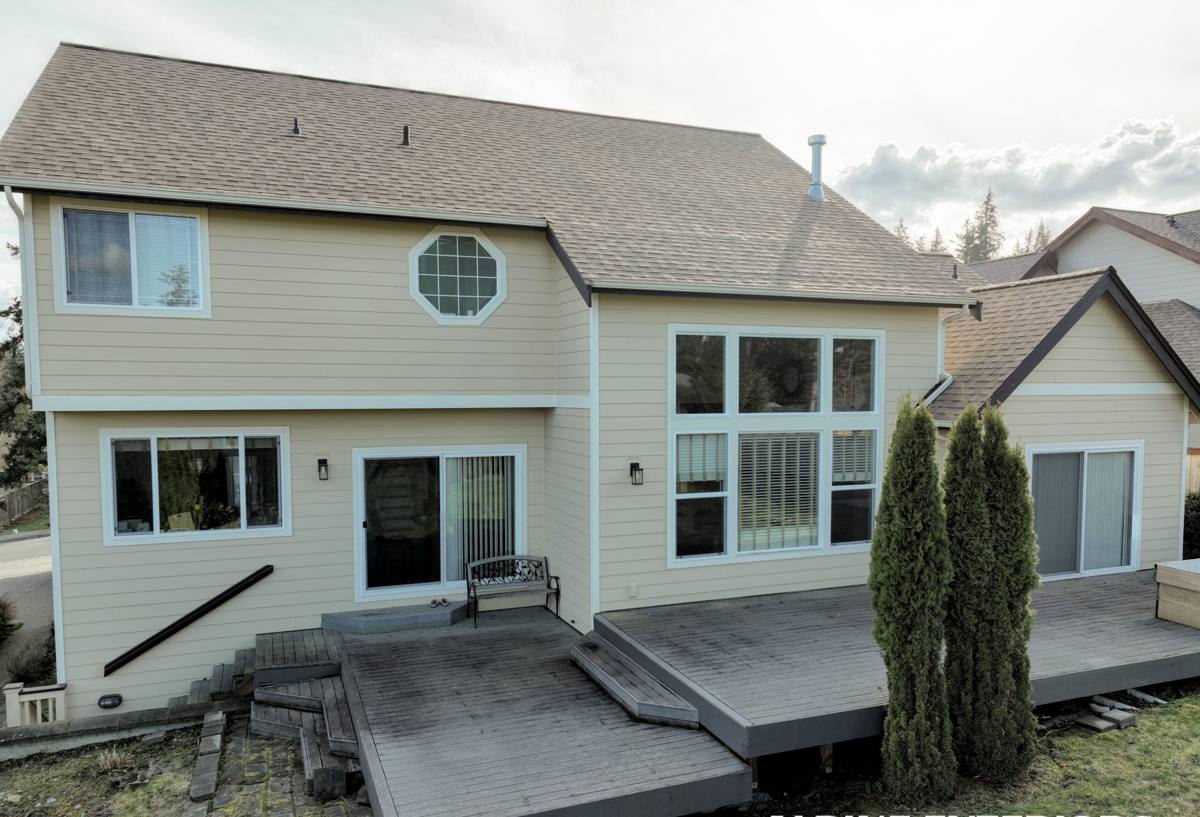
 Composite Decking Built for Eastlake Woodlands
Eastlake Woodlands homeowners live with a specific mix of conditions: long stretches of intense Florida sun, heavy summer humidity, sudden downpours, and the occasional tropical system pushing wind-driven rain sideways across a deck. Whatever decking material goes down here has to handle all of that at once, every year, without needing constant attention. Composite decking, installed correctly, is one of the few options that does.
We work on decks throughout Oldsmar and the surrounding Pinellas County area, and Eastlake Woodlands comes with its own set of considerations — tree canopy in parts of the neighborhood that shades some decks and keeps them damp longer after rain, open backyards elsewhere that take the full brunt of sun and wind, and the usual Gulf-coast humidity that never really lets up. A deck built without those specifics in mind tends to show problems within a few seasons: boards that cup, fasteners that back out, or a substructure that rots out from underneath a perfectly good deck surface.
Why the Climate Here Is Hard on Decking
Pinellas County sits in a subtropical zone with high year-round humidity, intense UV exposure, and a hurricane season that runs six months out of the year. Individually, any one of these is manageable. Together, they wear down decking materials faster than most homeowners expect.
- UV exposure: Florida sun breaks down wood fibers and degrades cheap composite formulations, leading to fading, surface chalking, and brittleness over time.
- Humidity and moisture: Constant moisture in the air, plus afternoon storms, keeps deck surfaces and substructures damp for long periods — ideal conditions for rot, mold, and fastener corrosion if the wrong materials are used.
- Wind-driven rain: During storms, rain doesn't just fall straight down — it drives sideways and gets pushed into board gaps, ledger connections, and railing posts.
- Salt air: Even set back from the coast, Pinellas County properties get enough salt air drift to accelerate corrosion on hardware, brackets, and fasteners that aren't rated for it.
- Hurricane-force wind: Framing, railings, and attachment points all need to be engineered to hold together under real wind loads, not just look good on a calm day.
None of this means composite decking is a bad choice for Eastlake Woodlands — quite the opposite. Composite boards resist rot, don't splinter, and hold up to UV far better than untreated wood. But "composite decking" covers a wide range of quality and installation practices, and in this climate, the difference between a correct install and a shortcut one shows up fast.
What Fails First When a Deck Isn't Built Right for This Area
Most of the composite deck problems we get called out to inspect trace back to the same handful of issues: substructure lumber that wasn't properly treated or sealed at cuts, fasteners that corrode and stain the boards, inadequate spacing between boards for expansion and drainage, and ledger or post connections that weren't flashed properly against wind-driven rain. The composite boards themselves are rarely the actual failure point — the framing and detailing underneath usually are.
What a Correct Composite Deck Install Involves
A composite deck is only as good as what's underneath it. We treat the substructure with the same seriousness as the visible decking, because that's what actually determines how the deck performs over the next 15-25 years.
Substructure and Framing
We use pressure-treated or corrosion-resistant framing appropriate for our humidity, with proper joist spacing for the specific composite product being installed — composite boards often require tighter joist spacing than wood to prevent sagging over time. Every cut end of treated lumber gets sealed, since a raw cut is where rot starts first.
Fasteners and Hardware
Stainless steel or coated fasteners rated for coastal/high-humidity environments go in every connection point, including hidden fastener systems where the composite product calls for them. Using the wrong hardware here is one of the most common shortcuts we see, and it's also one of the most damaging — corroding fasteners stain boards and weaken over time.
Drainage and Ventilation
Proper board spacing, ledger flashing, and airflow underneath the deck keep moisture from sitting against the structure after our frequent afternoon storms. A deck that traps moisture underneath it is a deck that's rotting from below, even if the composite surface looks fine.
Railings and Attachment Points
Railing posts and ledger connections are engineered to hold up under real wind load, not just pass a casual glance. This matters more in open, less-sheltered yards common in parts of Eastlake Woodlands than it does in tightly built-up areas.
Comparing Decking Options for This Climate
| Material | UV/Fade Resistance | Moisture Resistance | Maintenance | Typical Lifespan |
|---|---|---|---|---|
| Pressure-treated wood | Fades and grays without regular treatment | Prone to rot if not sealed/maintained | Annual sealing or staining | 10-15 years |
| Basic composite | Moderate — can fade or chalk over time depending on formulation | Good, resists rot | Occasional cleaning | 15-20 years |
| Premium capped composite | Strong UV resistance from protective cap layer | Excellent — capped boards resist moisture intrusion | Minimal — soap and water cleaning | 20-30 years |
We generally steer homeowners toward capped composite products for this area specifically because of the UV load and humidity — the cap layer is what stands between the board and years of intense sun and moisture cycling. It costs more upfront than basic composite or pressure-treated wood, but in this climate it's the difference between a deck that still looks good in year 15 and one that needs boards replaced by year 8.
Our Process for Eastlake Woodlands Decking Projects
- On-site assessment: We look at sun exposure, drainage patterns, existing structure (if replacing a deck), and any tree canopy or shading that affects moisture retention.
- Material selection: We walk through composite board options and hardware based on the specific site conditions, not a one-size-fits-all recommendation.
- Permitting: Deck work typically requires permitting through the appropriate local jurisdiction — we handle that process rather than leaving it to the homeowner.
- Framing and substructure build: Treated framing, sealed cuts, corrosion-resistant hardware, and joist spacing matched to the chosen composite product.
- Decking installation: Boards installed with correct spacing, hidden or approved fastening systems, and attention to drainage underneath.
- Railings and finish work: Railings engineered for wind load, trim and fascia work completed, site cleaned up.
- Final walkthrough: We go over the finished deck with the homeowner, including basic care expectations for the specific product installed.
What to Ask Before Hiring Anyone for Composite Decking
A lot of deck problems in this area aren't a materials issue — they're an installation issue. Before hiring any contractor for composite decking in Eastlake Woodlands, it's worth asking a few direct questions.
- Do they pull permits for deck work, or do they suggest skipping that step?
- What fastener and hardware system do they use, and is it rated for coastal/humid environments?
- How do they handle joist spacing for composite boards specifically, versus standard wood spacing?
- Do they seal cut ends of treated lumber during framing?
- Can they explain how the deck will drain and ventilate underneath, not just how it looks on top?
- Do they carry insurance and offer a workmanship warranty separate from the manufacturer's material warranty?
If a contractor can't answer these clearly, that's worth noting before signing anything.
Why Local Experience in Eastlake Woodlands Matters
A crew that already works in Eastlake Woodlands and the broader Oldsmar area has already seen how the local mix of sun exposure, humidity, tree cover, and storm patterns plays out on real decks — not just in a manufacturer's spec sheet. That local familiarity shows up in small decisions: how tight to space boards for our humidity swings, which orientation gets hit hardest by afternoon sun, where drainage tends to pool after a heavy storm, and how railings need to be anchored for wind here versus a drier, calmer climate.
It also matters for the practical side of a project — knowing the local permitting process, understanding typical lot layouts and setback rules in the area, and being available for follow-up if a question comes up after the install rather than being a crew that worked one job in the neighborhood and moved on.
Maintaining a Composite Deck in This Climate
One of the real advantages of composite decking is how little upkeep it needs compared to wood — but "low maintenance" doesn't mean "no maintenance," especially with our humidity and pollen/mildew growth.
- Rinse and clean the surface periodically to prevent mildew buildup, especially in shaded or low-airflow areas of the deck.
- Keep gutters and downspouts near the deck clear so runoff doesn't pool against the structure.
- Check railing and post connections periodically, particularly after major storms.
- Trim back overhanging vegetation that keeps sections of the deck shaded and damp longer than the rest.
- Address any staining near fasteners early — it usually signals a hardware issue worth checking before it spreads.
If you're planning a new composite deck or replacing an aging one in Eastlake Woodlands, we're happy to take a look and talk through what makes sense for your specific yard and sun exposure. The estimate is free, there's no pressure to move forward, and you'll get a straight answer about materials and cost before any work starts — just fill out the form below.